Surgery guide · Nose
Rhinoplasty Materials in Korea — Cost, Methods, Benefits & Risks (2026)
Primary rhinoplasty (bridge + tip) in Korea costs US$4,310–6,390 (₩5.8M–8.6M) in clinic surgery fees, based on 13 written quotes from 5 Gangnam clinics issued to MISOODA patients between November 2024 and March 2026. Complex, open or revision cases were quoted US$8,090–15,340. Most international patients stay 7–10 days. Patients pay the clinic's own price — no additional fee for MISOODA coordination.
Rhinoplasty Materials in Korea is performed at internationally recognised Gangnam clinics, typically costing USD $2,300–$12,000 in 2026. As a Korean government-registered facilitator for international patients (Reg. A-2014-01-01-1414) with 12+ years, MISOODA connects you with 150+ verified clinics at the same price as locals — no hidden fees, no ghost doctors.
✓ 12+ years✓ Same price as locals✓ No ghost doctors
On this page
2026 quick answer
Rhinoplasty in Korea — the short answer
Rhinoplasty (nose surgery) in Korea costs about US$2,300–$12,000 in 2026, depending on the method and material — typically 30–50% less than the US, UK or Australia. Most international patients stay 7–10 days; initial swelling settles in 1–2 weeks and the final result appears in 3–6 months. The most natural, long-lasting results use autologous (your own) cartilage — septal, ear or rib — while silicone and Gore-Tex implants suit bridge augmentation. With MISOODA you pay the same price as Korean locals at 150+ verified Gangnam clinics.
- Cost (2026)
- US$2,300–$12,000
- Stay in Korea
- ~7–10 days
- Recovery
- 1–2 wks swelling · 3–6 mo final
- Best material
- Autologous cartilage
- Foreigner markup
- None — local price
- Free quote
- Within 24h (USD)
Guide
Latest Trend of Rhinoplasty in Korea
Rhinoplasty, commonly known as a nose job/ nose surgery, is a plastic surgery procedure for correcting and reconstructing the nose form and aesthetically reshaping or resizing the nose. It can correct a variety of concerns, including a visible bump on the nasal bridge, a droopy or bulbous nasal tip, a nose that’s off-center or deviated. However, the idea of nose surgery 2(Rhinoplasty) in Korea also called as an Asian Rhinoplasty, is designed to give a “Western” appearing nose by enhancing and reshaping the nasal bridge and tip.
Here is the most common nose surgery procedure,
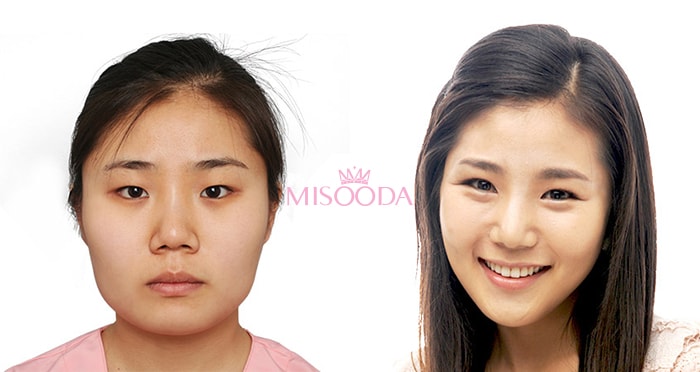
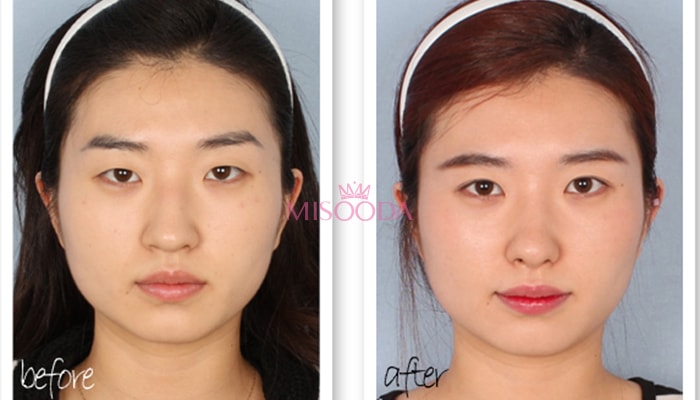
The nose is the most prominent feature on the face. Therefore, it is one of the most important facial features that determine the overall impression of one’s look. A tall and high nose alone cannot be the standard of a beautiful nose. Natural-looking nose which harmonizes with the overall facial proportion is as important as making a high nose.
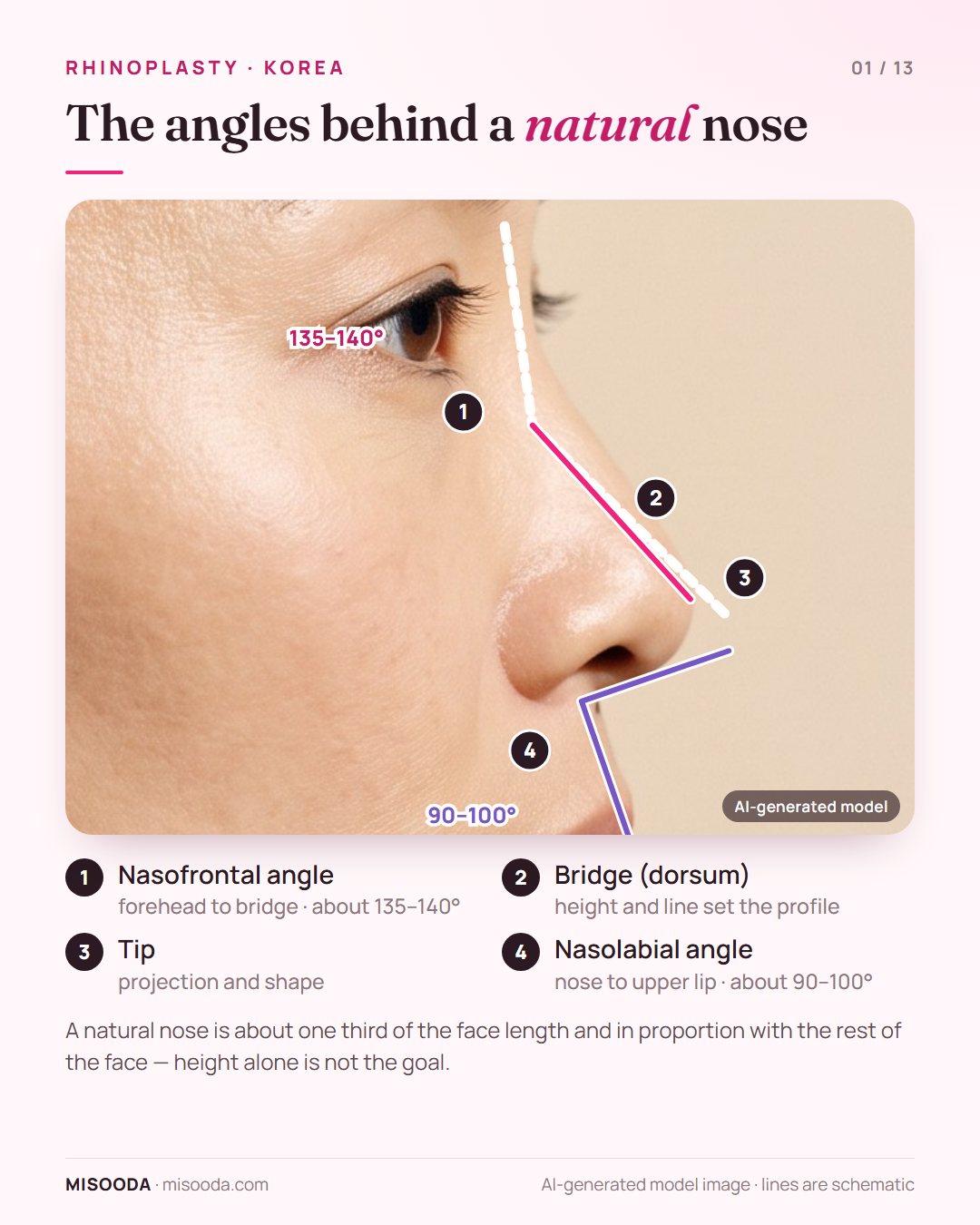
The perfect ratio of a beautiful nose is the consideration of the nose length, nasofrontal angle (between forehead and nose bridge) and nasolabial angle (between nose and upper lip). The ideal nose length takes up about one third of the face. The ideal angle of nasofrontal is about 135~140 degree which matches along the nasolabial angle, 90~100 degrees.
The nose shape preference has changed over generations. Back then people only preferred a straight and high nose but now there are straight, curvy or straight-curvy nose shapes that people can choose from. The nose shape also needs to be decided after considering patients ideal nose and the overall facial harmony.
Guide
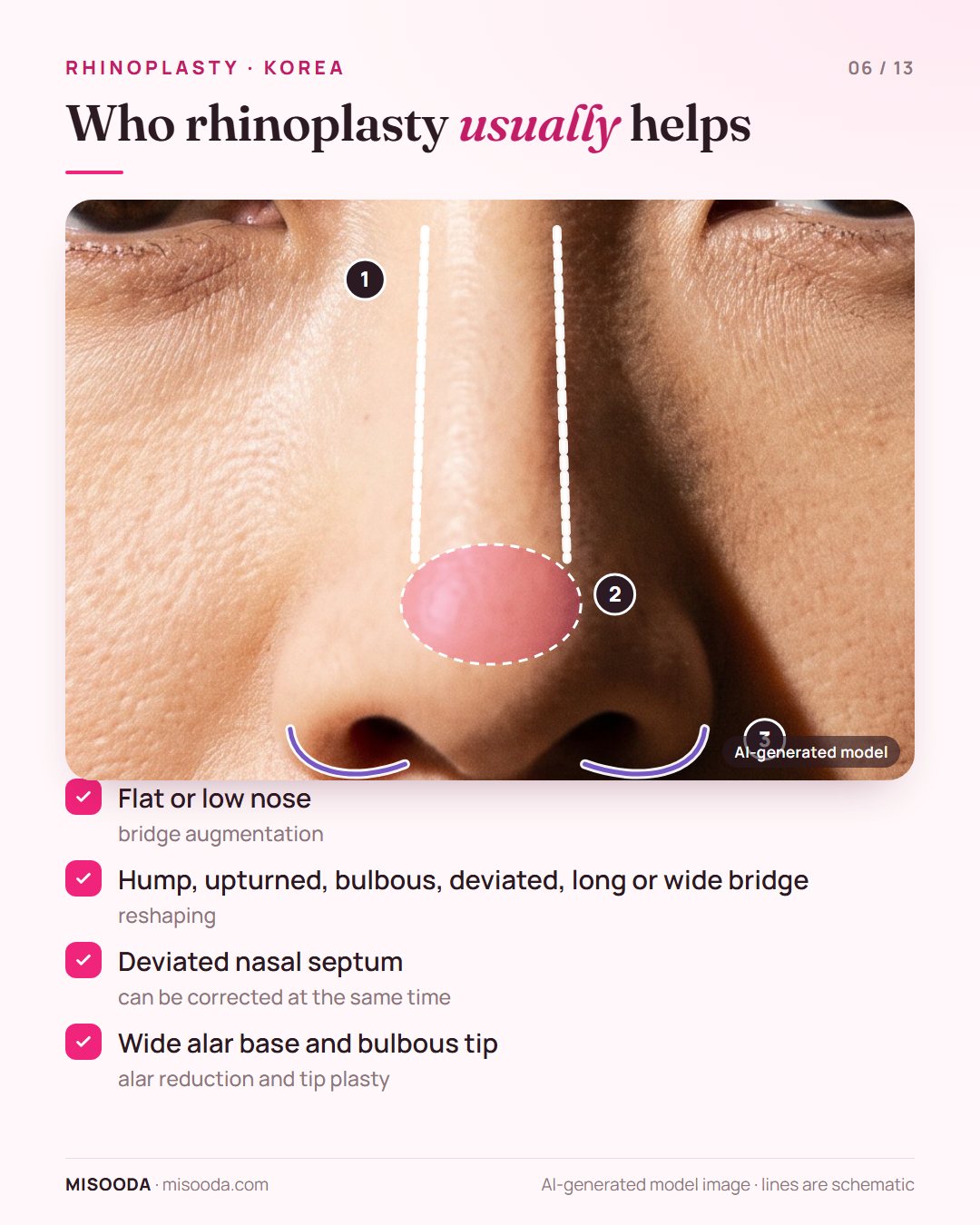
Who are the candidates for nose surgery/rhinoplasty?
- Those who have flat/low noses
- Those with a humped nose, an upturned nose, a bulbous nose, a deviated nose, long nose, and wide nasal bridge
- Those with deviated nasal septum
- Those with wide alar and bulbous nose tip
- Those who want to change their image that they already have
Here are the nose surgery procedures what these candidates need, case by case:
Materials
Rhinoplasty Materials
Implant
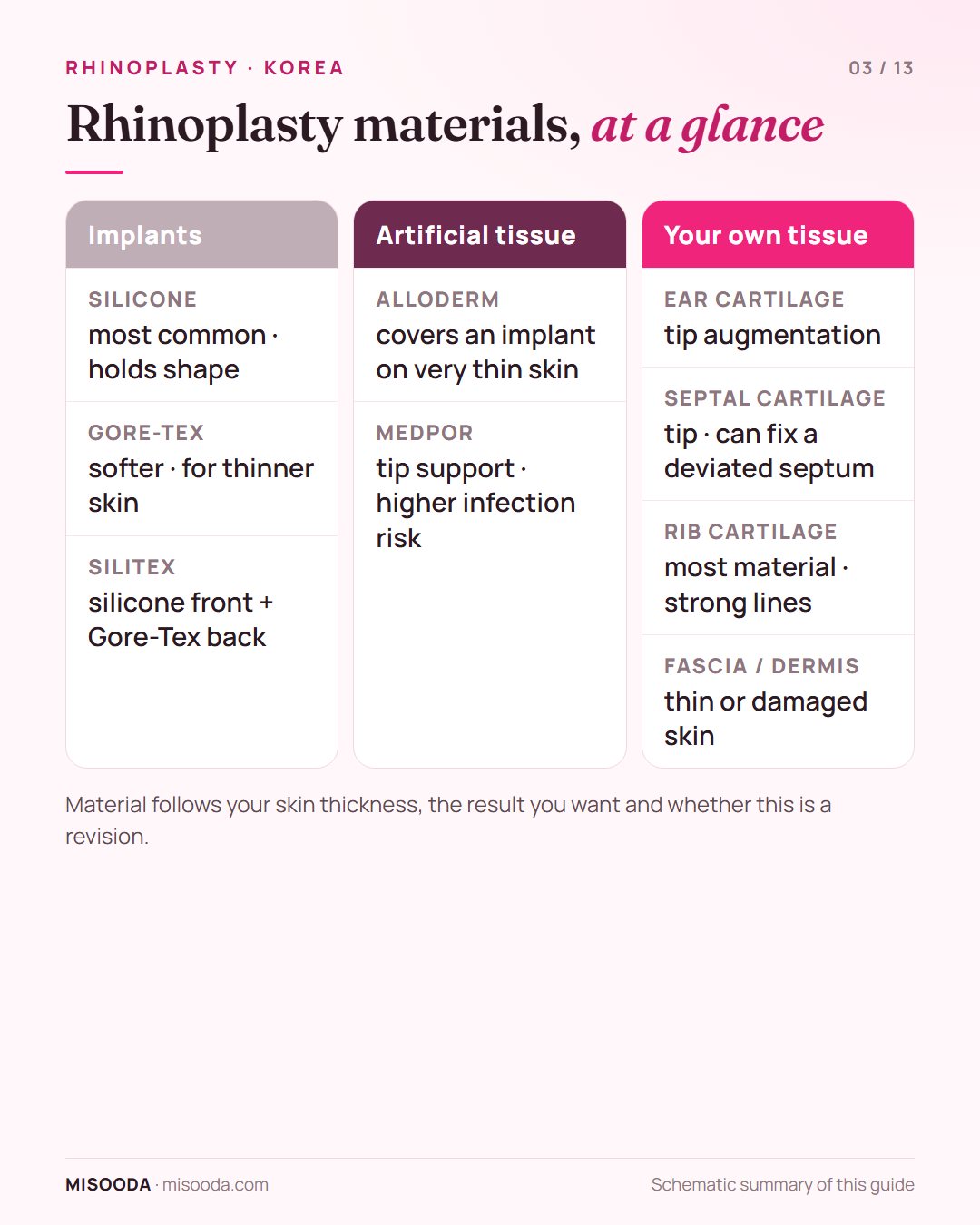
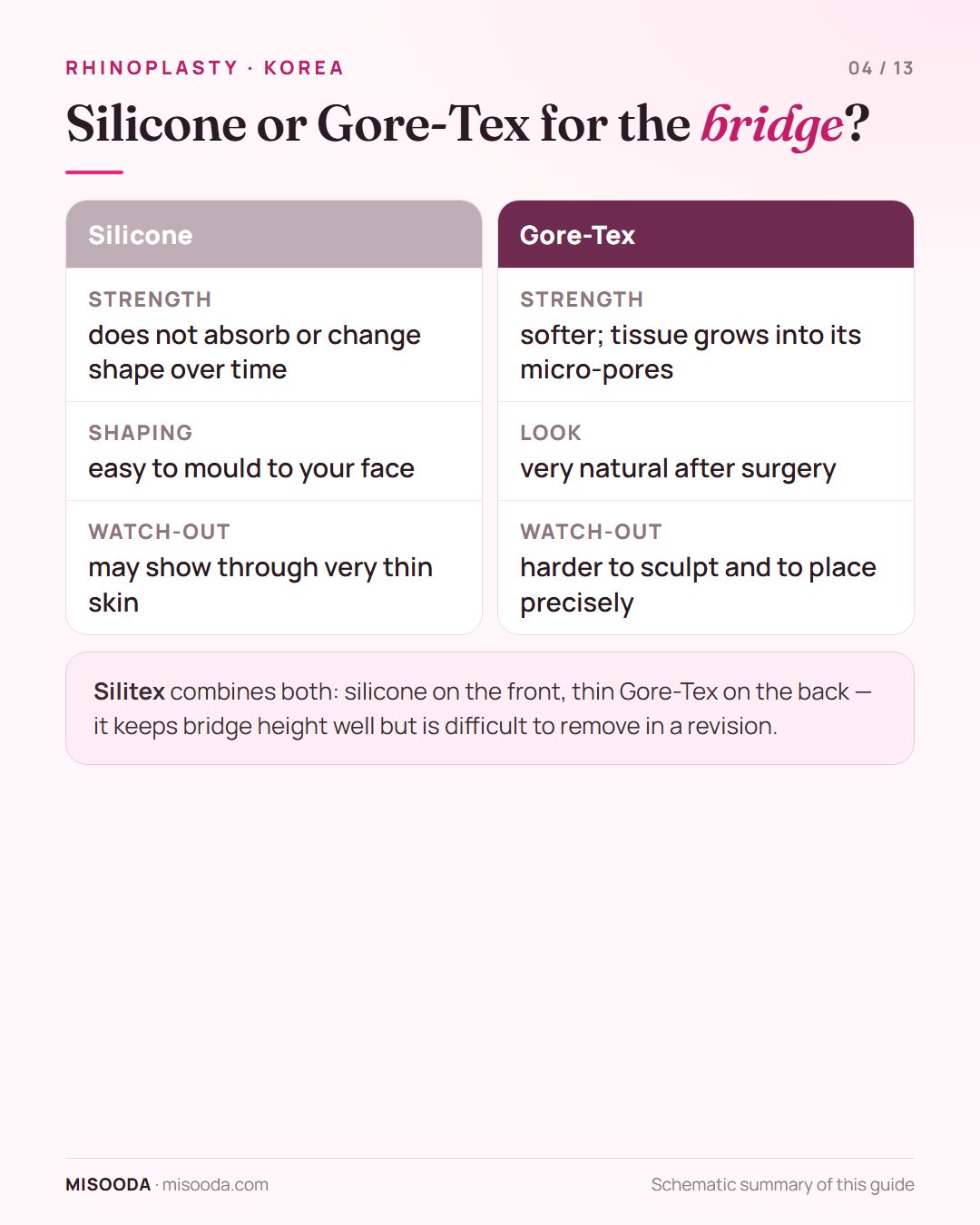
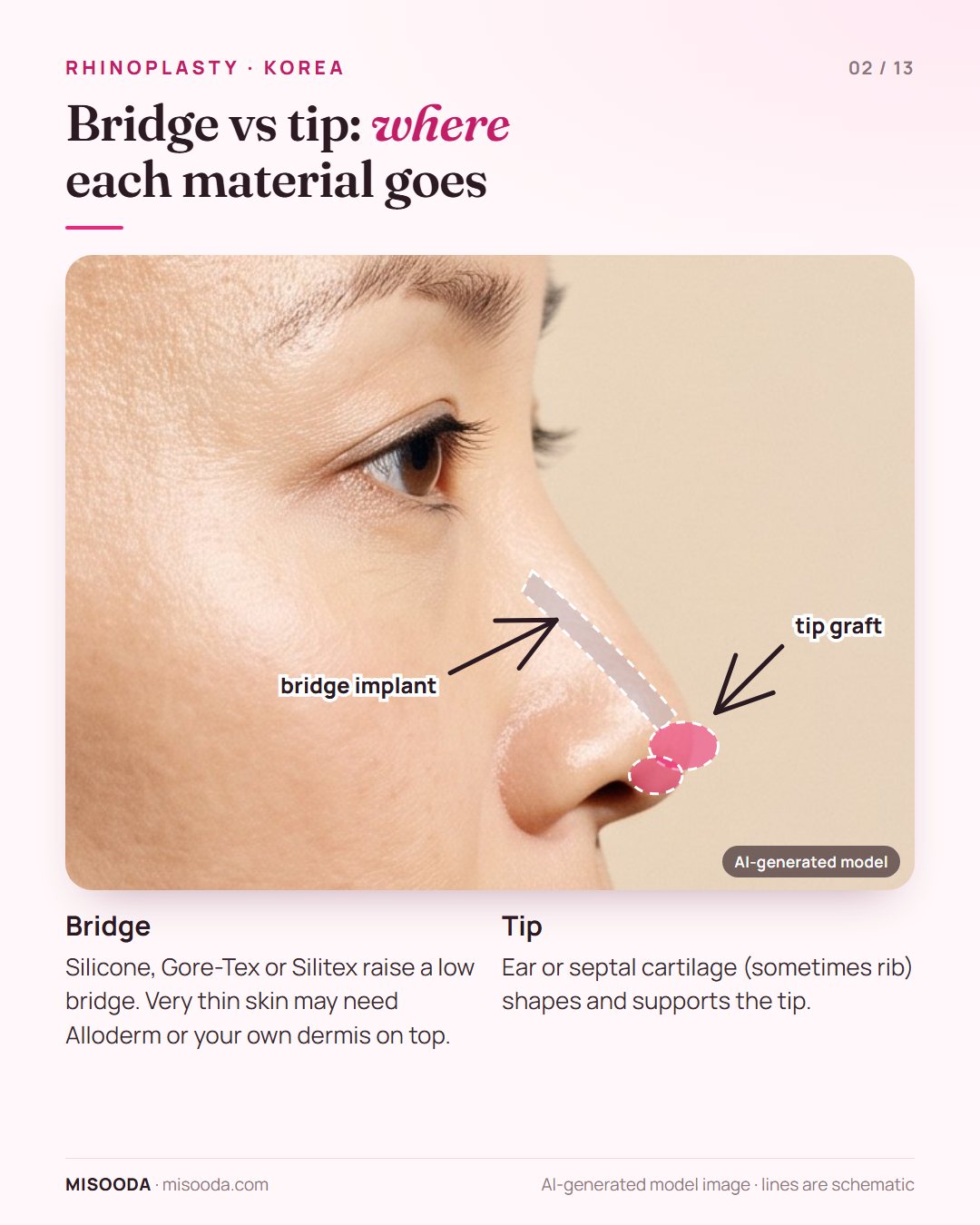
Silicone: Silicone implant is the most common and longest used type of implant for rhinoplasty. It does not absorb nor does it change in shape even after a long lapse of time. In addition, it is easy to mould silicone into various shapes, considering the patient’s facial characteristics. If the patient’s skin is too thin, the implant may be seen through the skin. Proper implants should Silicone: Silicone implant is the most common and longest used type of implant for rhinoplasty. It does not absorb nor does it change in shape even after a long lapse of time. In addition, it is easy to mould silicone into various shapes, considering the patient’s facial characteristics. If the patient’s skin is too thin, the implant may be seen through the skin. Proper implants should be used considering the patient’s skin thickness and conditions.be used considering the patient’s skin thickness and conditions.
Gore-Tex: Gore-Tex, widely applied to vascular surgery, has been proven to be safe. As Gore-Tex is softer than Silicone implant, it can be used for those who have thinner skin. In addition, it looks very natural after an operation. Gore-Tex easily assimilates into the tissues and develops few complications such as foreign body reactions due to its microscopic holes. Because of its soft texture, it is difficult to sculpt it into a desired shape or to insert it into the proper location.
Silitex: Silitex is an implant consisting of silicone on the front and thin Gore-Tex on the rear. It has the advantages of both silicone and Gore-Tex. Since bearing capacity is high, there is no risk of lowering the height of the nose bridge. So, the height Alloderm: Human dermis is processed to prevent rejection reactions. If the patient has extremely thin skin, Alloderm may be added to the top of an implant to reduce the see-through phenomenon. It is thin and partially absorbable. Alloderm is expensive so it’s not appropriate to use in a simple rhinoplasty context. and shape of nose bridge stays well. It is normally difficult to remove when doing revision surgery.
Artificial tissue
Alloderm: Human dermis is processed to prevent rejection reactions. If the patient has extremely thin skin, Alloderm may be added to the top of an implant to reduce the see-through phenomenon. It is thin and partially absorbable. Alloderm is expensive so it’s not appropriate to use in a simple rhinoplasty context.
Medpor: Medpor is a replacement or additional material for Septal cartilage when the nose tip is augmented. This material has more possibility of infection so it is not suitable for everyone. One disadvantage is that it is difficult to remove if a revision surgery has to be done because it sticks to the tissues.
Autologous tissue
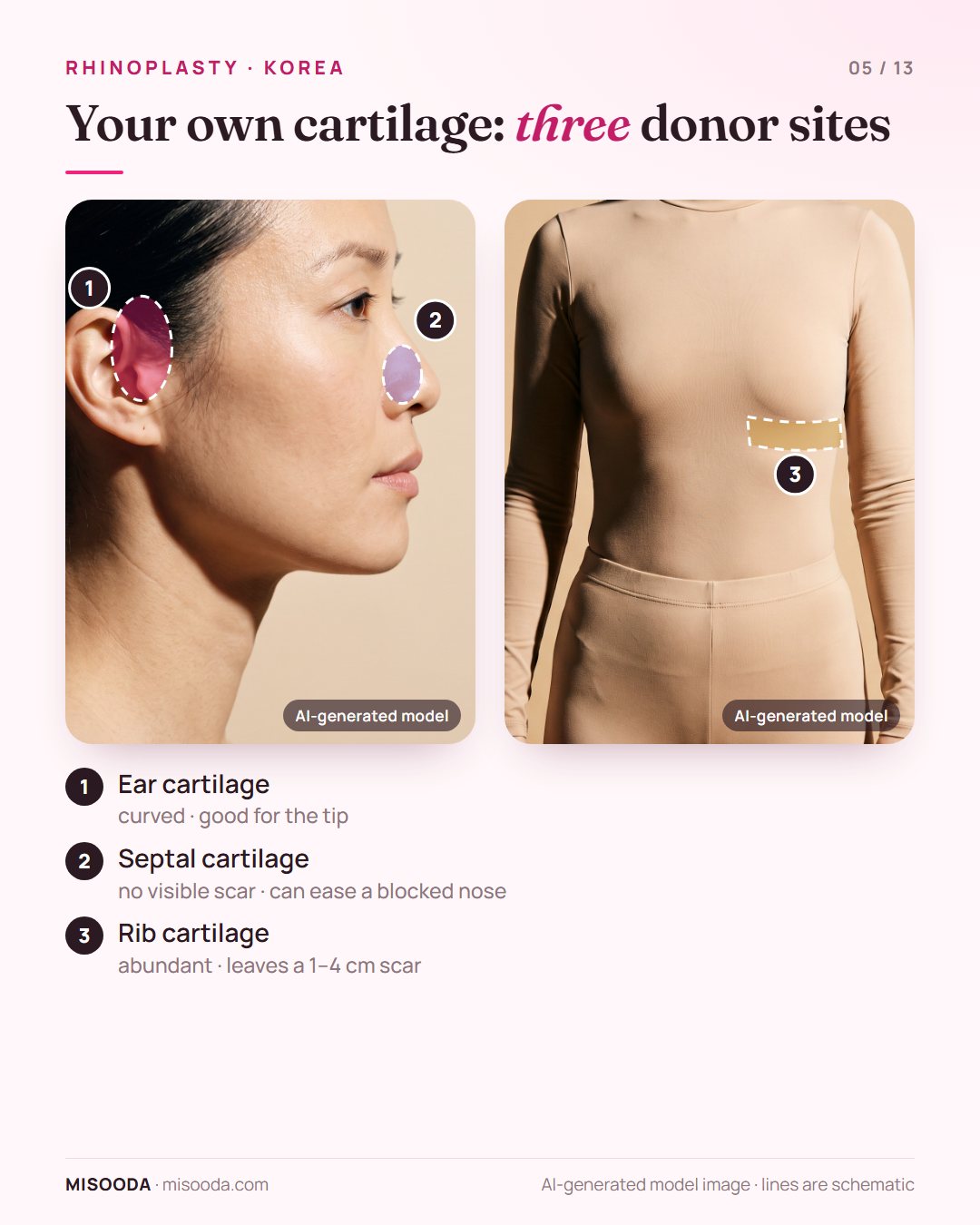
Ear Cartilage: They are generally used for nose tip augmentation. It doesn’t break easily and can make multiple layers with it. The cartilage is curved so making a natural-looking nose tip at any angle is possible however, since it is curved, one limitation is that there is only one point that holds the tip down firmly.
Septal Cartilage: It does not leave any scars or have any functional or structural problem after harvesting the septal cartilage. It is possible to correct a deviated nasal septum through rhinoplasty and also nasal stuffiness may improve. The nose tip is normally hard and doesn’t go upwards when pushed up (also known as the piggy nose move). Also, there is a limit on the amount of septal cartilage being harvested.
Rip Cartilage: There are abundant rib cartilages to be harvested. It is possible to produce a variety of shapes and lines. It can create a well-defined looking nose. Scars are visible at the rib cartilage harvested area (from 1-4 cm). You can feel that the nose is hard and may cause distortion after collection.
Fascia, Autologous dermis: Autologous dermis can be used when skin of nose bridge is damaged or very thin due to repetitive surgeries. Autologous dermis is collected from the buttock or groin or fascia from the scalp. It can be inserted on its own or inserted together wrapping the implant for nasal bridge augmentation in extremely thin skin cases. Since these are not foreign substances, they are safe and create a natural-looking nose. The fascia may be absorbed over time and the harvested site leaves a small scarring. Surgery is a little complicated with long operation time.
Guide
Korean Nose Surgery/ Rhinoplasty Cost
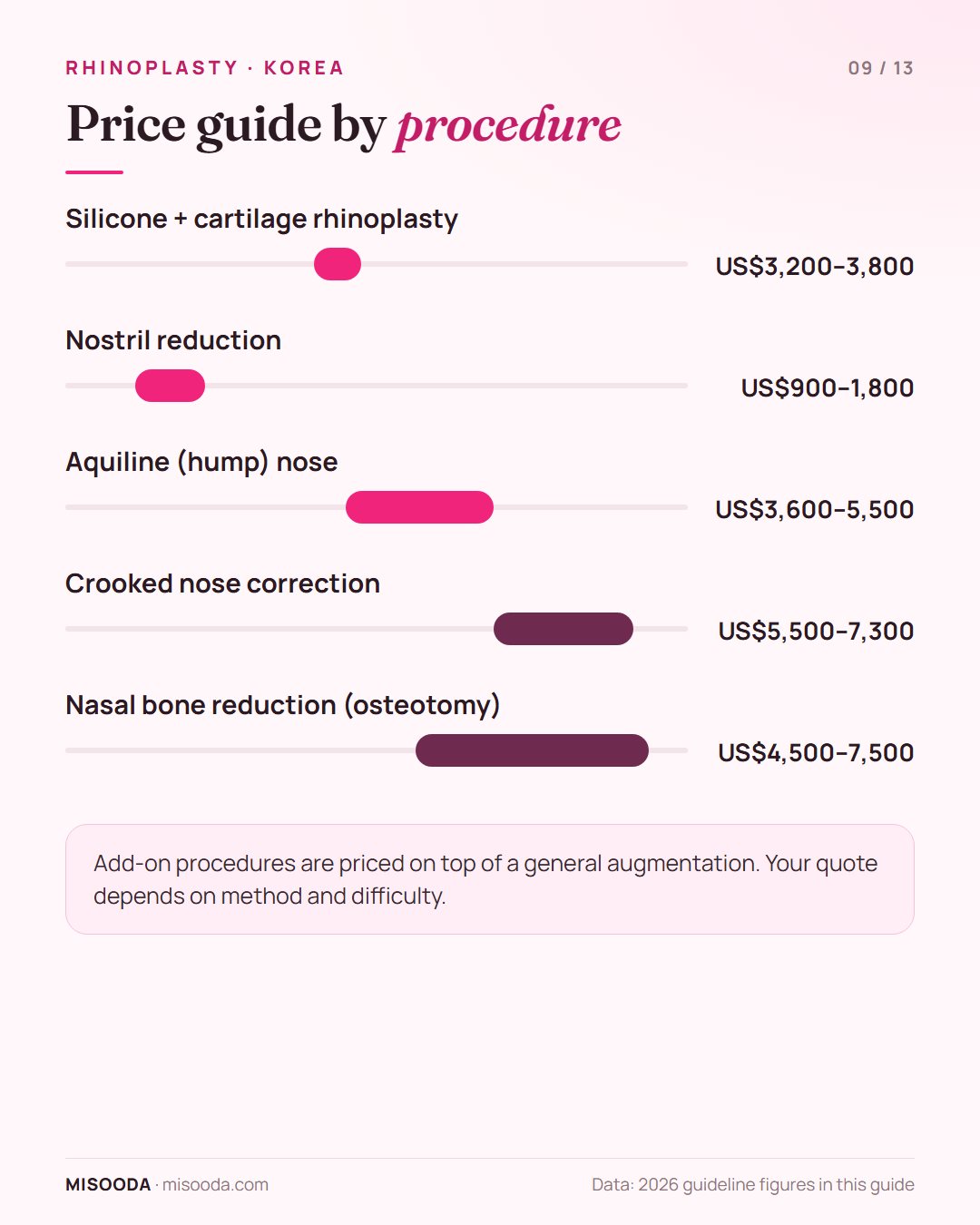
General price guide line for Korean Nose Surgery/ Rhinoplasty is USD$900 to USD$7,500 according to Korea Health Industry Development Institute. The price is decided depending on the method and difficulty of patients’ case. The procedures below can be added on the top of general nose augmentation and the price will be in variable range.
Nose Surgery Precautions
Post-operative Precautions
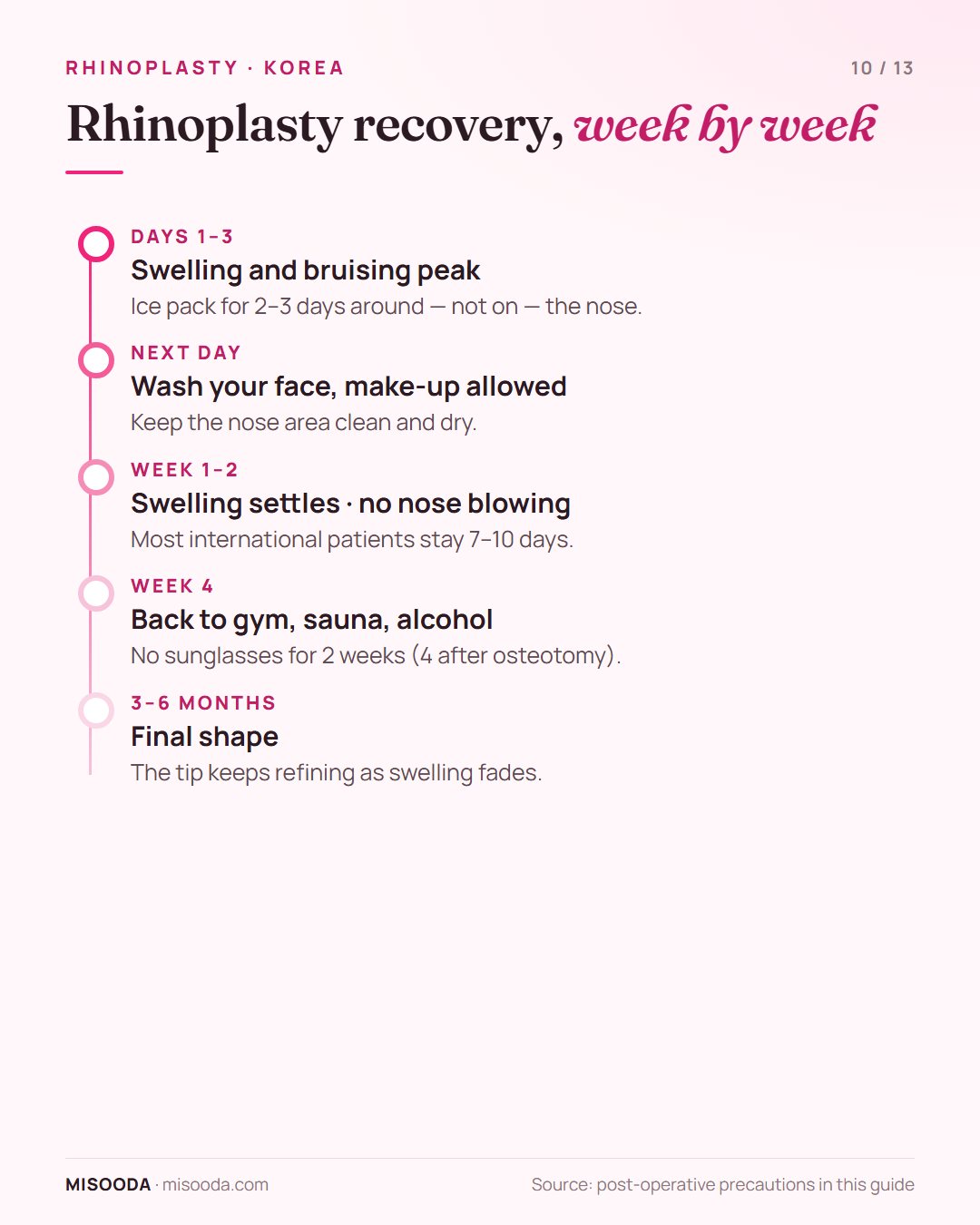
1. Swelling and bruises will occur for 3 days after the surgery but they will be gradually subside afterwards.
2. Applying ice-pack for 2-3 days will be helpful. Apply the ice pack around the surgical area but not on the nose bridge or nose tip.
3. Facial wash and make-up can be done the next day after surgery avoiding the nose area.
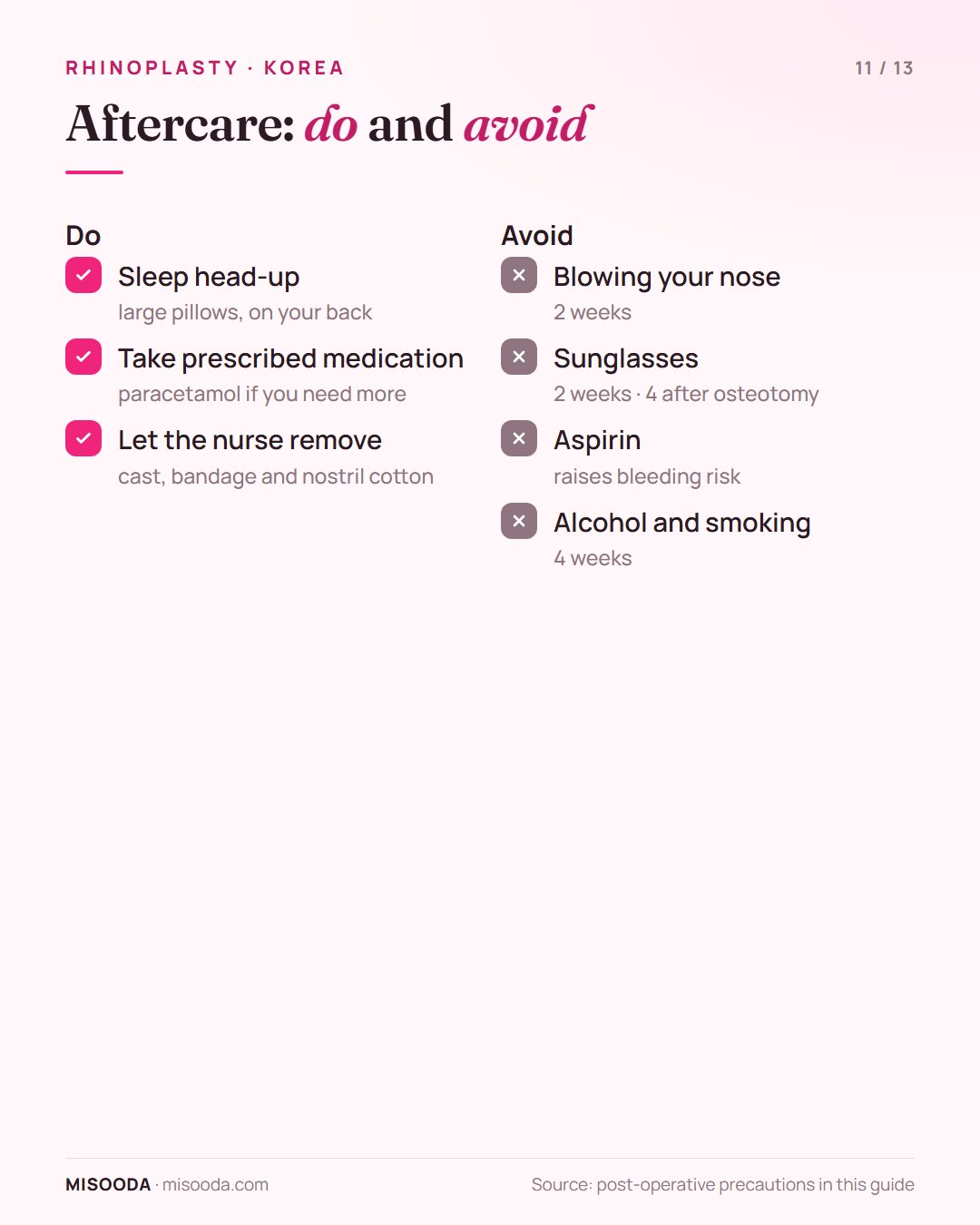
4. Please do not remove bandages or cast or cottons inside of your nostrils until a nurse does it.
5. Please avoid blowing your nose for 2 weeks. In case of a nosebleed, gently wipe out the blood. Please avoid putting tissues inside your nostrils. It is normal to have a small amount of nose bleed for 2-3 days after the surgery.
6. Please avoid wearing sunglasses for 2 weeks in case of a simple rhinoplasty and for 4 weeks in case of nasal bone reduction.
7. Please avoid heavy exercise such as aerobics, gym for 4 weeks. However, going for a walk is recommended.
8. Shower can be done on the next day of the stitch removal, but please avoid sauna and hot spring for 4 weeks.
9. Please avoid bowing of the head or lying face down.
10. Supporting your head higher with large pillows is helpful in reducing swelling or pain. Do not turn your neck sideways or lie face down, but try to sleep in a straight position as much as possible.
11. Please take the prescribed pain killers and antibiotics. In case you require additional pain killers, take Tylenol (paracetamol), or medication that does not contain aspirin. Aspirin related pain medication might cause bleeding, therefore is not recommended.
12. Drinking and smoking should be avoided for 4 weeks. Alcohol can cause infection and smoking can damage/necrotize skin or delay wound recovery as it contracts vessels
Reference
Rhinoplasty Materials — at a glance
| Part |
From (USD) |
To (USD) |
|
Rhinoplasty (Silicone + cartilage) |
3,200 | 3,800 |
| Nostril Reduction | 900 | 1,800 |
| Aquiline Nose Rhinoplasty | 3,600 | 5,500 |
| Crooked Nose Correction | 5,500 | 7,300 |
|
Nasal Bone Reduction(Osteotomy) |
4,500 | 7,500 |
2026 guideline figures; vary by clinic and case.
Why MISOODA
Same price, more protection, even more perks
What's included
You pay the same price as Korean locals — no foreigner markup. As a Korean government-registered facilitator for international patients since 2014 (Reg. A-2014-01-01-1414) we compare 150+ verified Gangnam clinics, arrange English coordination, and support your rhinoplasty materials journey from quote to aftercare.
✓ Same price as locals✓ No hidden fees✓ Board-certified surgeons✓ No ghost doctors
Price comparison
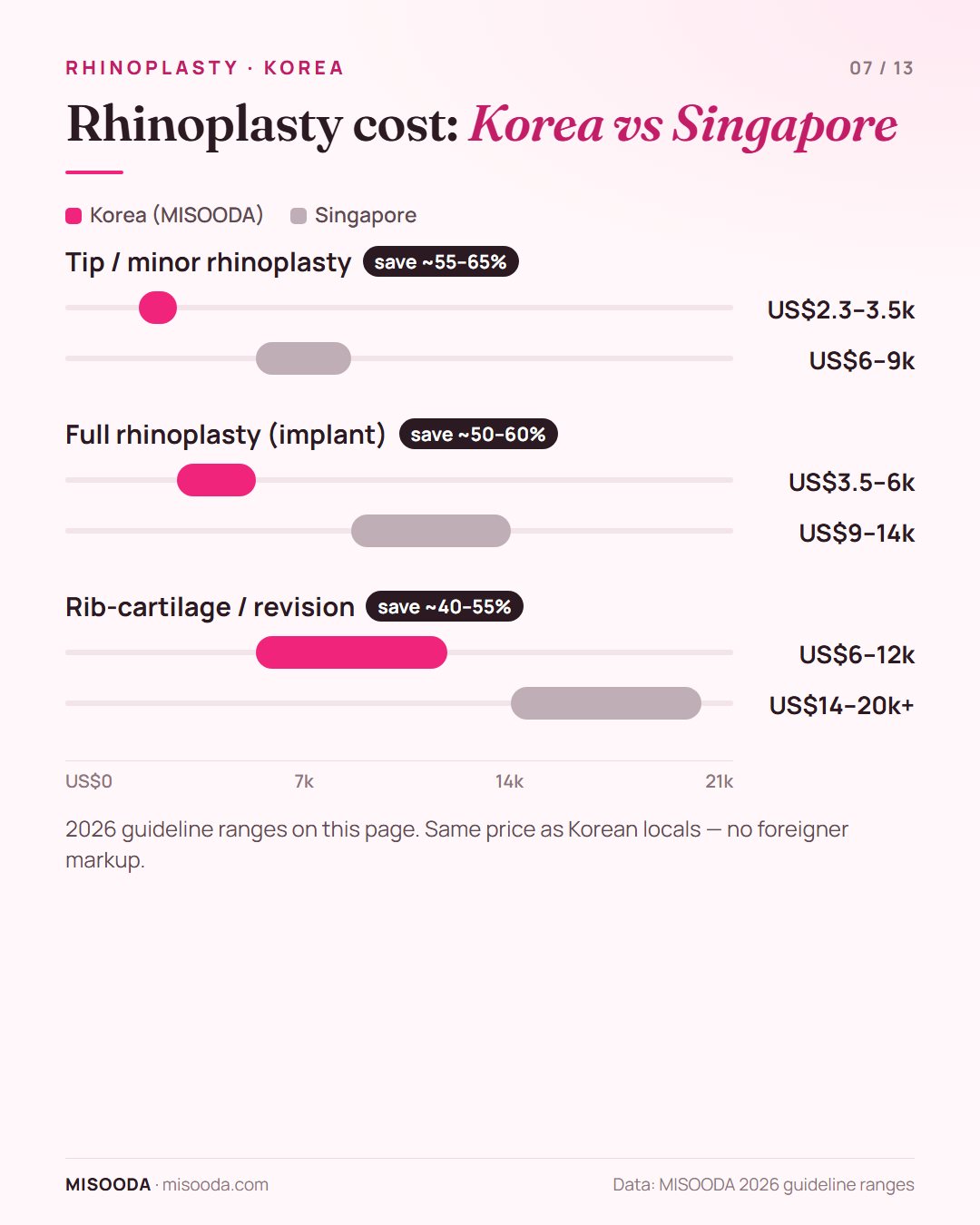
Rhinoplasty cost: Korea vs overseas (2026)
Approximate 2026 all-in ranges. With MISOODA you pay the same price as Korean locals — no foreigner markup.
| Procedure | Korea (MISOODA) | Singapore | You save |
|---|---|---|---|
| Tip / minor rhinoplasty | US$2,300–3,500 | US$6,000–9,000 | ~55–65% |
| Full rhinoplasty (implant) | US$3,500–6,000 | US$9,000–14,000 | ~50–60% |
| Rib-cartilage / revision | US$6,000–12,000 | US$14,000–20,000+ | ~40–55% |
2026 guideline figures; exact price varies by clinic and case — get a free itemised quote in 24h.
Total cost
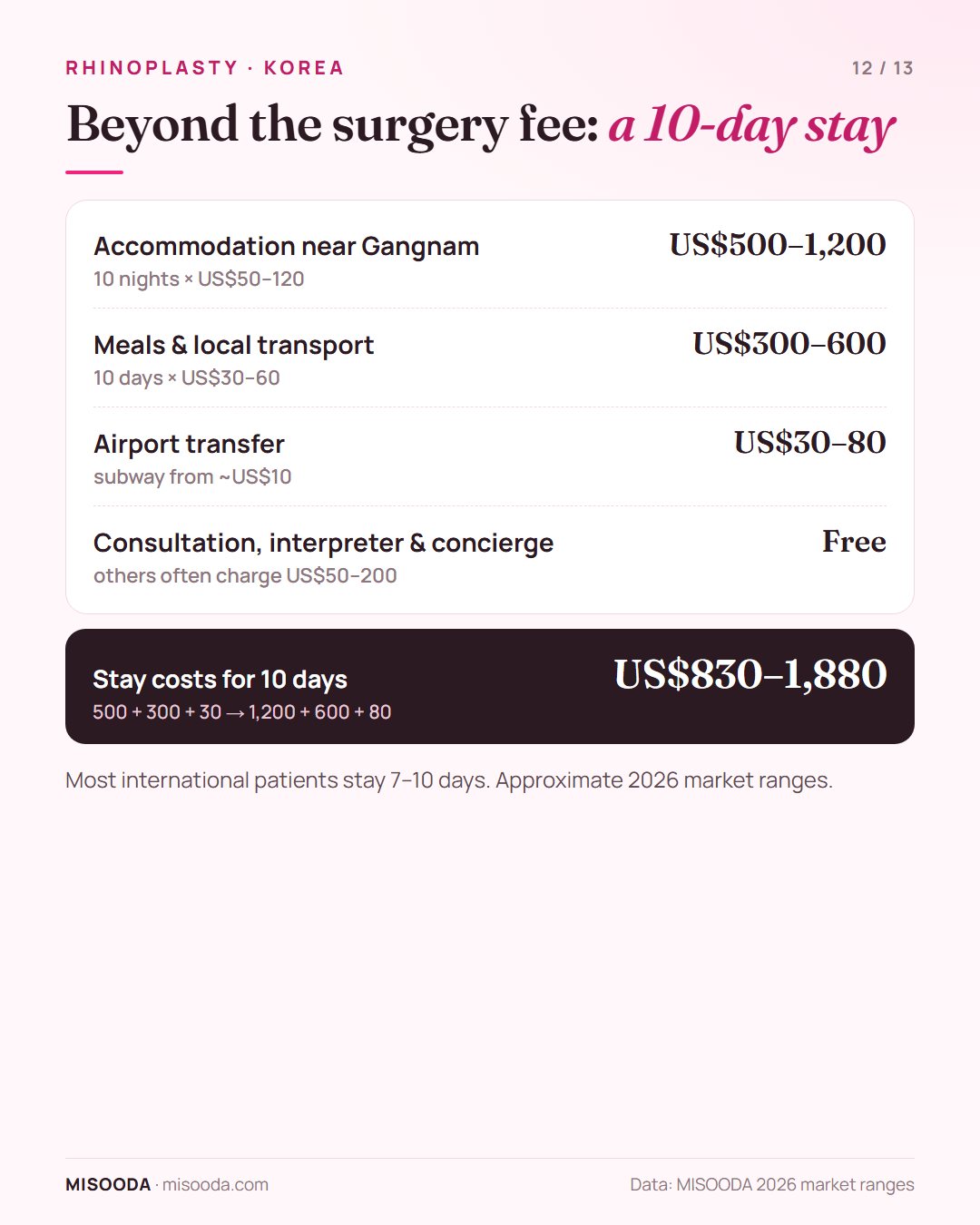
Beyond surgery: what else to budget in Korea
The surgery fee is the main cost. For a realistic total, plan for a short recovery stay — most patients stay about 1–2 weeks.
| Item | Approximate 2026 |
|---|---|
| Consultation + interpreter & concierge | Free with MISOODA (others often US$50–200) |
| Accommodation near Gangnam | US$50–120 / night |
| Meals & local transport | US$30–60 / day |
| Airport transfer | US$30–80 (subway from ~US$10) |
| Optional post-op care (de-swelling / LED) | from ~US$30 / session |
Approximate market ranges for a ~2-week stay; your MISOODA case manager gives a personalised, itemised estimate — free quote in 24h.
Real quotes
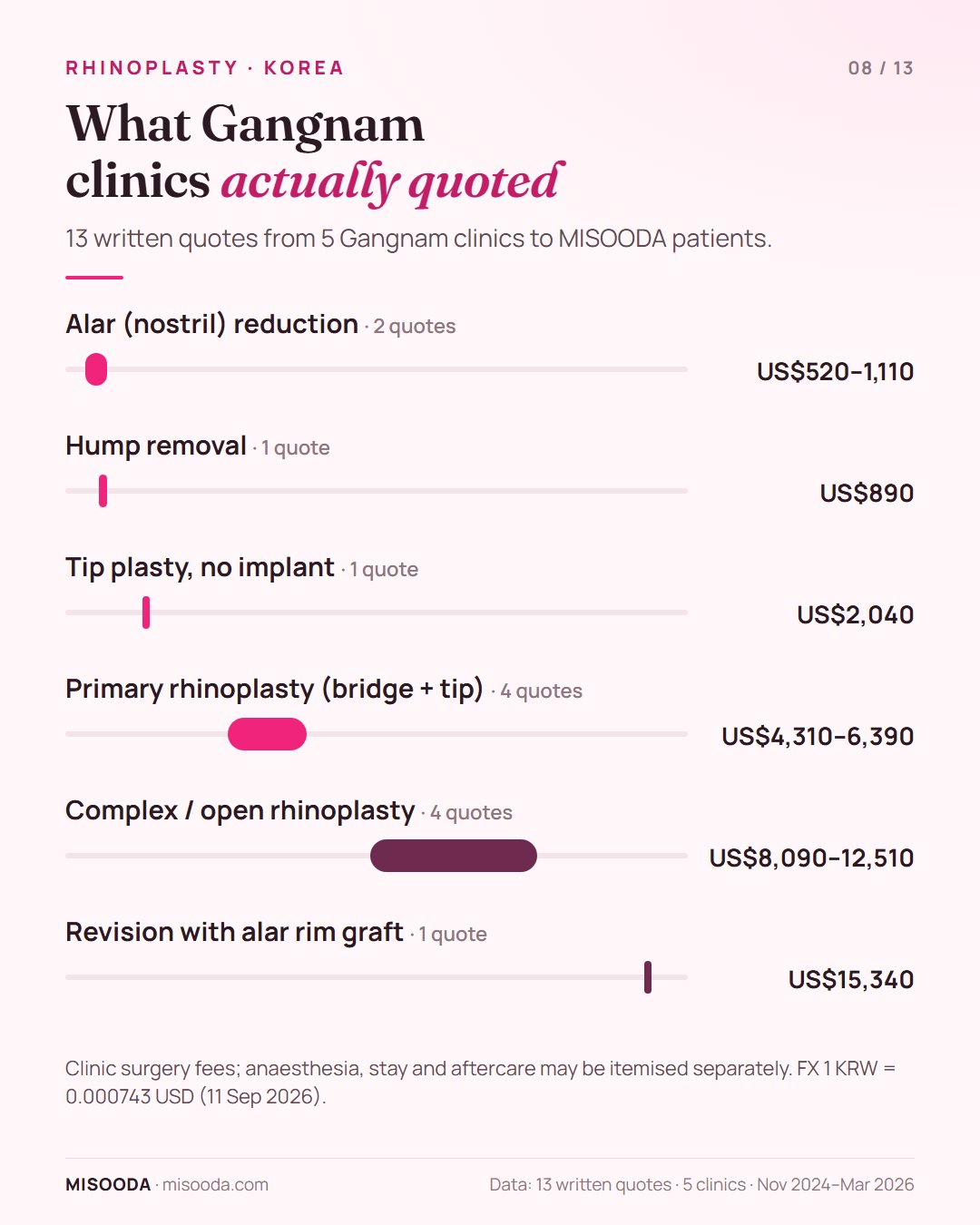
What Korean clinics actually quoted for rhinoplasty (2024–2026)
13 written quotes from 5 Gangnam clinics issued to MISOODA patients between November 2024 and March 2026 (BRAUN, Dream, Wonderful, Returning, 345). Non-surgical items (fat grafting, skin devices, Botox) are excluded.
| Procedure | Line items | Quoted range (KRW) | ≈ USD |
|---|---|---|---|
| Alar (nostril) reduction, alone | 2 | ₩0.7M–₩1.5M | US$520–US$1,110 |
| Hump removal, alone | 1 | ₩1.2M | US$890 |
| Tip plasty without implant | 1 | ₩2.75M | US$2,040 |
| Primary rhinoplasty (bridge + tip) | 4 | ₩5.8M–₩8.6M | US$4,310–US$6,390 |
| Complex / open rhinoplasty (osteotomy, septal or rib cartilage, alar work) | 4 | ₩10.89M–₩16.84M | US$8,090–US$12,510 |
| Revision rhinoplasty with alar rim graft | 1 | ₩20.64M | US$15,340 |
Quotes are per case and per clinic — anaesthesia, hospital stay and post-op care may be itemised separately. Not a guarantee of price or result. FX: 1 KRW = 0.000743 USD (11 Sep 2026). Cartilage source (septal, ear, donor rib), implant material and revision status drive most of the spread.
Plastic surgeons at the clinics that issued these quotes
The quotes do not name the operating surgeon; these are the board-certified plastic surgeons currently listed for those clinics on MISOODA.
- Dr. Tae-Gyu Kim — plastic surgeon, BRAUN Plastic Surgery (20 years)
- Dr. Ji-won Lee — plastic surgeon, BRAUN Plastic Surgery (12 years)
- Dr. Dong-wan Ryu — plastic surgeon, BRAUN Plastic Surgery (12 years)
- Dr. Yang Soo Park — plastic surgeon, Dream Plastic Surgery (33 years)
- Wonderful Plastic Surgery — surgeon profiles on the clinic page
Real rhinoplasty results from MISOODA patients
Verified before-and-after reviews written by patients who booked through MISOODA. Photos and stories are theirs, not stock images.
Read all verified patient reviews →


Good to know
Frequently asked questions
How much does Rhinoplasty Materials cost in Korea?+
How many days do I need in Korea for Rhinoplasty Materials?+
Is Rhinoplasty Materials in Korea safe for foreigners?+
Do I pay the same price as Korean locals?+
How safe is rhinoplasty materials in Korea?+
What is recovery like after rhinoplasty materials?+
Why do people choose Korea for rhinoplasty materials?+
Who is a good candidate for rhinoplasty materials?+
How long do I need to stay in Korea for rhinoplasty materials?+
What's included in the price for rhinoplasty materials?+
Can rhinoplasty materials be combined with other procedures?+
Is there a tax refund for plastic surgery in Korea in 2026?+
Do I still pay VAT on cosmetic surgery in Korea?+
How can I save on plastic surgery in Korea now that the tax refund ended?+
How much does rhinoplasty cost in Korea?+
Is Korea good for nose jobs?+
Which country is best for rhinoplasty?+
Is Turkey or Korea better for rhinoplasty?+
Keep exploring